
Twins: creating and training yours
Build a Twin, decide what it learns from, choose who can talk to it, and see what people use it for.
What a Twin is
A Twin is an AI model of you. It learns how you take in information, how you weigh a decision, how you communicate, and how you tend to respond, and it answers questions the way you would tend to. You build it yourself and you give permission for it to exist.
Other people in your organization can talk to your Twin to prepare for a conversation with you. A Simulation, which is a discussion run by AI participants before the real people join, can include your Twin so that your point of view is represented when you are not there.
A Twin is a tool for preparation and practice. It does not act for you, it does not make decisions on your behalf, and it does not guarantee how you will actually respond. It does not speak in an imitation of your voice or appear in video. You decide what it learns from and whether it stays active.
Build your Twin
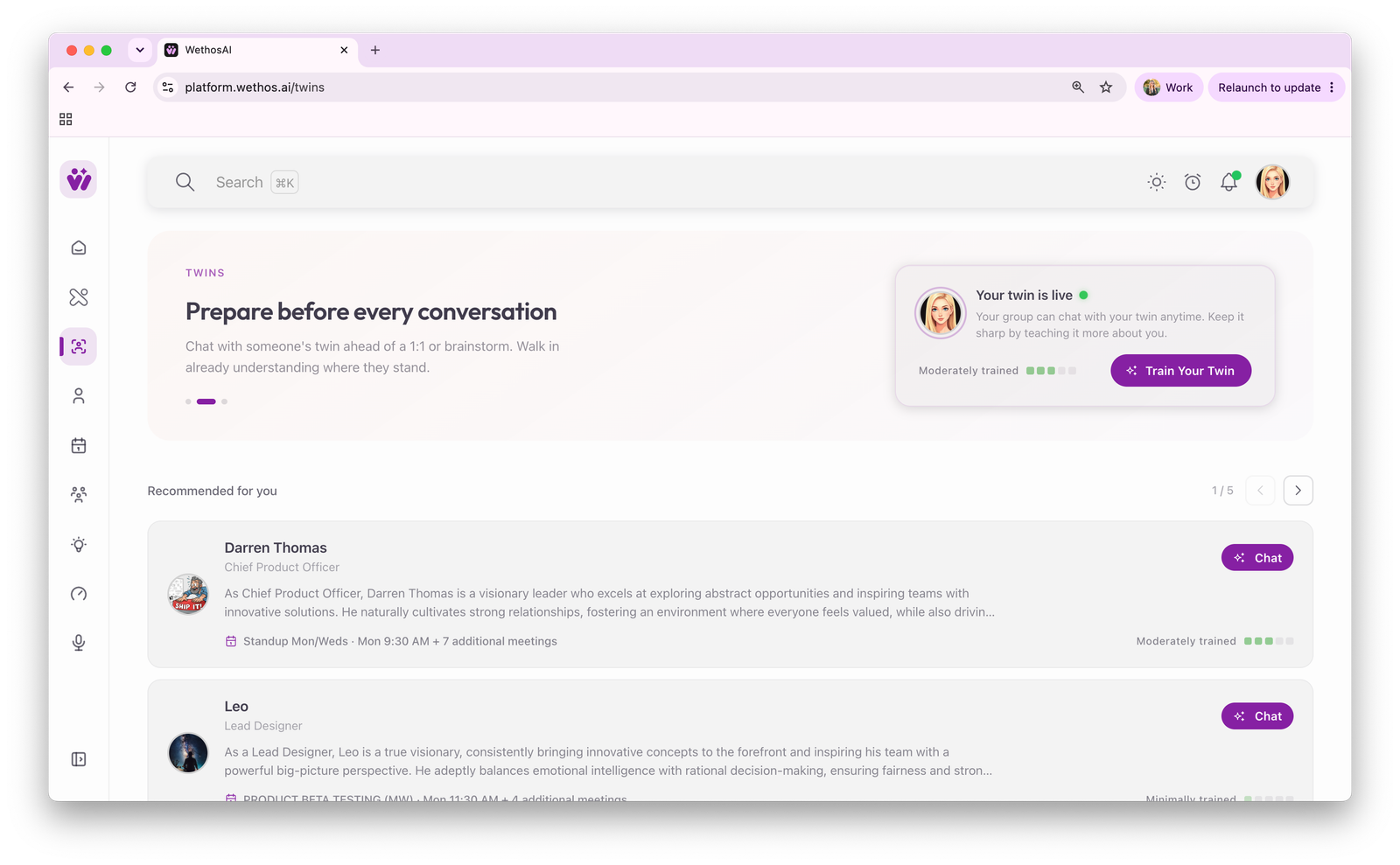
Click Twins in the left-hand menu. Your Twin starts from your profile, meaning the four dimensions and the traits and tendencies drawn from them, together with the About Me section of your profile page.
Add material. Give your Twin documents about you: a resume, things you have written, notes on how you like to work. The more it has to learn from, the more specifically it answers.
Record memories. Have a conversation with your Twin and tell it what you think. Explain how you reached a decision, what you want people to know before they bring you a proposal, or where you will not compromise. Each conversation teaches it something.
Watch the training level. The Twins page shows how much your Twin has learned so far. A Twin with little to learn from gives thin answers.
Who can talk to it
People in your organization can talk to your Twin, within whatever access your organization's settings allow. You control what your Twin learns from and whether it remains active. You can see what it has learned from, and you can withdraw it at any time.
Nothing your Twin learns is used to train AI models shared with other customers.
What people use a Twin for
- Preparing for a meeting with you. Someone who is about to bring you a recommendation asks your Twin how you are likely to read it, what you will probably ask first, and where you are likely to object. They arrive better prepared, and the meeting goes faster.
- Learning how you think before working with you. A new collaborator learns how you tend to make decisions without a week of guessing.
- Practicing a difficult conversation. Someone who has to bring you bad news, or disagree with you, can practice first.
A conversation someone has with your Twin belongs to them and is private to them. It is their preparation for a conversation with you. It is not a report about you, and it is not shared with you.
Talking to someone else's Twin
The Twins page suggests Twins of people you work with. Open one and ask what you would want to know before the real conversation. For example: "How will she react to a proposal that moves budget away from her team?" or "What does he want to see before he agrees to a timeline?"
Treat the answer as a guess to test in the real conversation. A Twin describes how someone tends to work. The person makes the decision.
Twins in a Simulation
When you run a Simulation, each participant who has built a Twin is represented by it. A participant who has not built a Twin is represented by a Virtual Member, which is a less detailed model built from public information. Virtual Members explains the difference, and Running a Simulation shows how both take part.
On mobile
Your Twin is available in the WethosAI apps for iOS and Android, so you can train it and consult it away from your desk.