


Cracker Barrel’s CEO is stepping down and being replaced by David Deno. Why?
We may never know the entire rationalization to Julie Masino’s departure but the logo reveal in 2025 is now being narrated as an essential component and significant marketing misstep. I do not believe that to be an accurate narrative.
My guess? It was a Decision Simulation failure. The new branding decisions were from a tight clustering of cognition that rinses and repeats from prior leadership successes rather than reads the (customer) room and executes with realtime telemetry (of alternate decision pathways).
Here’s the breakdown: on August 19, 2025, Cracker Barrel unveiled this ‘modernized’ wordmark. They stripped out ‘Old Timer’ — the overalls-clad figure they call Uncle Herschel. This wasn’t some random whim; it was part of a multi-year strategic transformation plan they’d announced back in May 2024, with roughly $700M on the line.
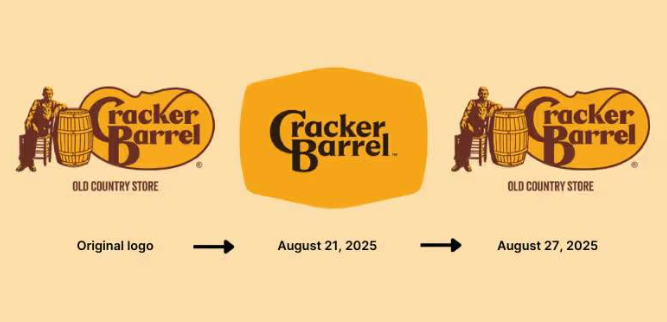
The backlash was immediate and brutal. The stock lost nearly $100M in market cap in a single session, and even President Trump weighed in. By August 27, they were scrambling to reverse it and put the original logo back. Nearly a year later, CEO Julie Felss Masino is gone, replaced by David Deno.
Now, let’s talk about the team’s cognitive composition. Masino’s resume is a straight line through brand-modernization roles: Starbucks, Godiva, Sprinkles Cupcakes, Fisher-Price at Mattel, and then Taco Bell. She was appointed CEO and a director in 2023 specifically to address the challenges the company faced. That’s a coherent story for sure. But it’s also a cognitive monoculture. Every one of those roles rewards the same instinct: reinvent the visual system, sharpen the value proposition for a younger consumer, and ship the refresh. Pattern driven perfection. Right?
Well the board she was executing with seemed to be aligned with that thesis as well. In 2024, Biglari asked shareholders to vote for him and Milena Alberti-Perez to replace two board directors, Carl Berquist and Meg Crofton. SEC filings even reveal that investor Sardar Biglari warned CEO Julie Felss Masino and her board at least four times the company was in ‘crisis,’ and the transformation plan was ‘obvious folly.’ But the board’s response, in its 2024 proxy materials, was to defend the plan and the slate. That’s not a board with a functioning devil’s advocate; that’s a board with a single, reinforced thesis.
The problem is, what’s missing from the composition is the person who thinks like the Cracker Barrel diner: rural or exurban, older, Southern-inflected, buying the brand precisely because it hasn’t changed. Nobody on the executive team or in the public-facing board bios has an operator résumé serving that customer identity. The team was cognitively long on ‘modernize the brand to grow’ and cognitively short on ‘the brand is the moat.’
If you had run the logo decision through an AI Decision Simulation, weighing the cognitive diversity of that room, the signal would have been loud and clear. On the axis that matters (cultural continuity versus brand modernization) the leadership team was heavily clustered on one pole. Every experience they collectively drew from told them modernization was the growth lever. There was no counterweight. The stress-test isn’t ‘will customers like the new logo?’ It’s ‘what happens when this specific team, with this specific composition, has to weigh identity risk against relevancy upside?’ The predicted output is the one that shipped: aggressive modernization, dismissed dissent, and then an identity backlash.
Or they could have asked Tommy Lowe, one of the Co-Founders.
The real lesson here? Cognitive diversity isn’t about demographics, tenure, or even resume variety. It’s about whether anyone in the decision room actually thinks like the customer you’re deciding for, and whether the people who don’t are willing to weight that voice before they ship. Without that, you’re just making guesses, and sometimes, those guesses cost you $100M in a day.